Firstly what does a influencial person means ? An influencial person simply means a person whose actions and opinions influence the course of events and mind of other people .
Here we are going to discuss about 3 of the most influencial women scientists and about there contributions to science .
Grace Brewster Murray Hopper (December 9, 1906 – January 1, 1992) was an American computer scientist and United States Navy rear admiral.One of the first programmers of the Harvard Mark I computer, she was a pioneer of computer programming who invented one of the first compiler related tools. She popularized the idea of machine-independent programming languages, which led to the development of COBOL, an early high-level programming language still in use today.
Prior to joining the Navy, Hopper attained a Ph.D. in mathematics from Yale University and was a professor of mathematics at Vassar College. Hopper attempted to enlist in the Navy during World War II but was rejected because she was 34 years old. She instead joined the Navy Reserves. Hopper began her computing career in 1944 when she worked on the Harvard Mark I team led by Howard H. Aiken. In 1949, she joined the Eckert–Mauchly Computer Corporation and was part of the team that developed the UNIVAC I computer. At Eckert–Mauchly she began developing the compiler. She believed that a programming language based on English was possible. Her compiler converted English terms into machine code understood by computers. By 1952, Hopper had finished her program linker (originally called a compiler), which was written for the A-0 System.
Awards adnd Honors
1.1964: Hopper was awarded the Society of Women Engineers Achievement Award, the Society’s highest honor, “In recognition of her significant contributions to the burgeoning computer industry as an engineering manager and originator of automatic programming systems.”
2.1969: Hopper was awarded the inaugural Data Processing Management Association Man of the Year award (now called the Distinguished Information Sciences Award).
3.1973: First American and the first woman of any nationality to be made a Distinguished Fellow of the British Computer Society.
4.military awards :
Top Row
Defense Distinguished Service Medal (1986)
Legion of Merit (1967)
Meritorious Service Medal (1980)
5.Grace Hopper was awarded 40 honorary degrees from universities worldwide during her lifetime.
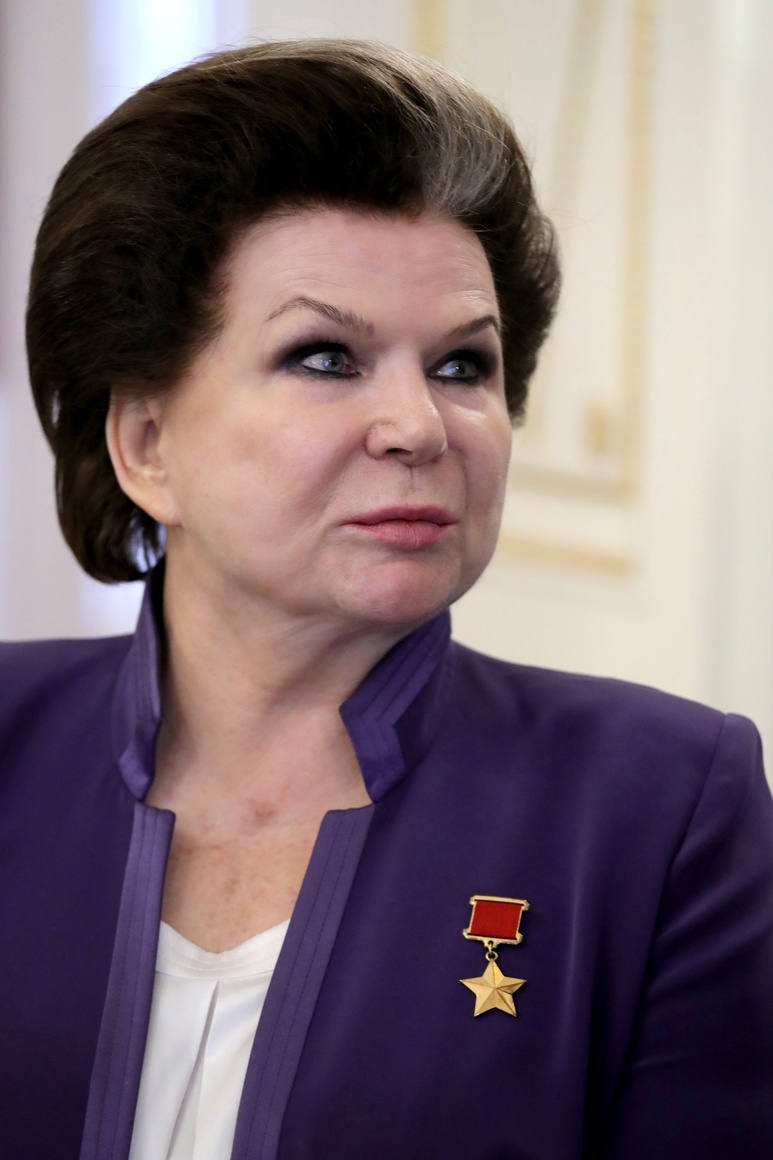
Valentina Vladimirovna Tereshkova , born 6 March 1937 , is a retired Russian cosmonaut, engineer, and politician. She is the firstwoman to have flown in space, having been selected from more than 400 applicants and five finalists to pilot Vostok 6 on 16 June 1963.
In order to join the Cosmonaut Corps, Tereshkova was honorarily inducted into the Soviet Air Force and thus she also became the first civilian to fly in space.[1]
Before her recruitment as a cosmonaut, Tereshkova was a textile-factory assembly worker and an amateur skydiver. After the dissolution of the first group of female cosmonauts in 1969, she became a prominent member of the Communist Party of the Soviet Union, holding various political offices. She remained politically active following the collapse of the Soviet Union
and is regarded as a hero in post-Soviet Russia and much of the world.
Having orbited Earth 48 times, Tereshkova remains the only woman ever to
have been on a solo space mission.[2][3]
In 2013, she offered to go on a one-way trip to Mars if the opportunity arose.
Tereshkova studied at the Zhukovsky Air Force Academy and graduated with distinction as a cosmonaut engineer. In 1977 she earned a doctorate in engineering.
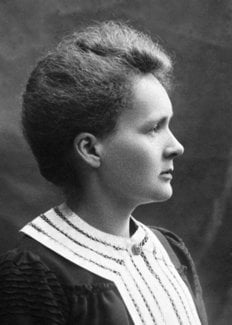
Marie Curie, née Maria Sklodowska, was born in Warsaw on November 7, 1867, the daughter of a secondary-school teacher. She received a general education in local schools and some scientific training from her father. She became involved in a students’ revolutionary organization and found it prudent to leave Warsaw, then in the part of Poland dominated by Russia, for Cracow, which at that time was under Austrian rule. In 1891, she went to Paris to continue her studies at the Sorbonne where she obtained Licenciateships in Physics and the Mathematical Sciences.She met Pierre Curie, Professor in the School of Physics in 1894 and in the following year they were married. She succeeded her husband as Head of the Physics Laboratory at the Sorbonne, gained her Doctor of Science degree in 1903, and following the tragic death of Pierre Curie in 1906, she took his place as Professor of General Physics in the Faculty of Sciences, the first time a woman had held this position. She was also appointed Director of the Curie Laboratory in the Radium Institute of the University of Paris, founded in 1914.
Curie throughout her life actively promoted the use of radium to alleviate suffering and during World War I, assisted by her daughter, Irene, she personally devoted herself to this remedial work. She retained her enthusiasm for science throughout her life and did much to establish a radioactivity laboratory in her native city – in 1929 President Hoover of the United States presented her with a gift of $ 50,000, donated by American friends of science, to purchase radium for use in the laboratory in Warsaw.
She won 2 noble prices:
A Noble prize in Physics for recognition of the extraordinary services they have rendered by their joint researches on the radiation phenomena discovered by Professor Henri Becquerel.
A Noble prize in Chemistry for recognition of her services to the advancement of chemistry by the discovery of the elements radium and polonium, by the isolation of radium and the study of the nature and compounds of this remarkable element.


 astro world